Why should your business name be the same everywhere?
Search engines and AI engines connect everything written about you by name. Variants can split those mentions across what look like several businesses, so pick one exact name and use it on your site, your Google profile, your socials and every directory.
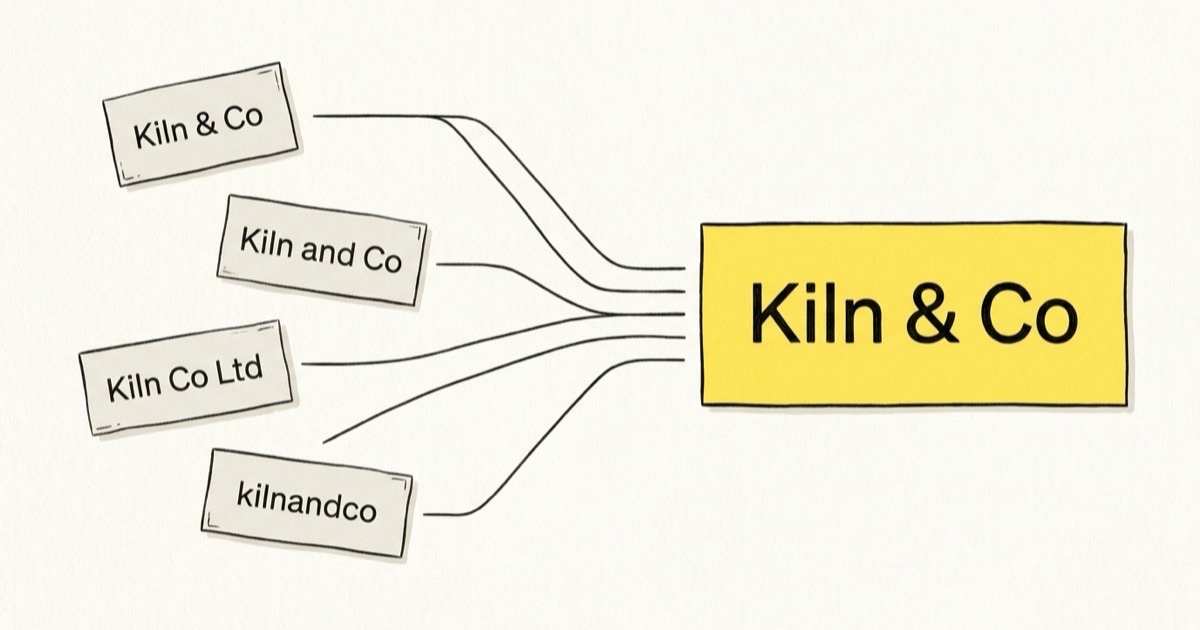
Because your name is how engines link together everything written about you. Every review, listing and article that mentions you is evidence an AI engine can use to recommend you, but only if it can tell all those mentions are about the same business. One exact name, used everywhere, makes that easy. Five variants make it guesswork.
What goes wrong when your name varies?
Picture a made-up pottery studio that trades as "Kiln & Co". Its website footer says "Kiln and Co Ceramics Ltd", its Google profile says "Kiln & Co Pottery Studio", Instagram says "kilnandco", an old directory listing still has the name from before a rebrand, and reviews call it "Kiln Co".
A person can see that these are one business. A machine has to decide, and every difference is a reason to doubt. When an engine builds its picture of a business, it gathers what it has read and groups it under one identity. Mentions it cannot confidently connect can be split off or ignored, and the studio risks looking like several small businesses with a few mentions each, instead of one business with plenty.
An engine asked to recommend a pottery class names a handful of businesses in one answer. The more of your mentions it can connect to you, the more evidence it has for putting you in that handful.
Which version of the name should you use?
The one customers say and search for. That is usually the name on your sign, your shopfront and your business cards.
Google's rules for Business Profiles make a good standard for everywhere else. The name "should reflect your business's real-world name, as used consistently on your storefront, website, stationery, and as known to customers." The same rules ban stuffing extras into it: no taglines, no service keywords, no location notes, and no "Ltd" unless you really trade under it. "Kiln & Co" passes. "Kiln & Co Pottery Classes Bristol" breaks the rules and can get a profile suspended.
Pick one form of every character and keep it. "&" or "and". "Co" or "Company". An apostrophe or none. Your legal name can live in the small print of your footer and on your invoices, where it belongs, while the trading name does the work everywhere else.
Your legal name belongs in the small print. Your trading name goes everywhere else.
Where does the name need to match?
Everywhere somebody might read about you, starting with the places you control:
- Your website. The title of your homepage, the header, the footer, the about page and the contact page.
- Your Google Business Profile, and the equivalent on Apple Maps and Bing Places if you have them.
- Your social profiles, including the display name, not only the handle.
- Directories and industry bodies. The trade association, the booking platforms and the listing sites people in your field use.
- Review sites where you can edit your own details.
Check your address and phone number while you are there. The same rule applies: one format, everywhere.
You cannot control what customers type in a review, and you do not need to. Consistency across the places you control gives an engine a strong identity to attach looser mentions to.
What should your about page say?
One plain paragraph a stranger could quote without changing a word: who you are, what you do, where, and since when.
"Kiln & Co is a pottery studio in Stokes Croft, Bristol, running wheel-throwing classes for beginners and open studio sessions since 2019."
That sentence gives an engine an unambiguous description to connect every other mention to. Put it on your about page, use a version of it as your Google Business Profile description, and reuse it in directory listings.
What about after a rebrand?
Old names linger on listings you forgot you had. After a rebrand, search for the old name in quotes, list every place it still appears, and update or claim each one. Where you cannot change a listing, ask the site to. Say "formerly Old Name" on your about page for a while, so anyone matching old mentions to the new name has a written link between them.
Do this today
- Write down your one name. Settle every character: ampersand or "and", "Co" or "Company", with or without "Ltd".
- Fix the places you control. Website header, footer, about and contact pages, Google Business Profile and social display names.
- Check your top three directories. Update the name, address and phone to match exactly.
- Add a quotable about paragraph. Who, what, where and since when, in one sentence a stranger could copy.
Once your name is consistent, find out whether AI engines name you when buyers ask.
More articles
All articles